- Home
- About Us
- Products
- Product knowledge
-
News Center
News Center
- Contact Us



For a long time, the refractory industry was trapped in the quagmire of "lowest-price bidding," where procurement focused on marginal differences in unit price while ignoring actual performance under extreme operating conditions. However, entering 2026, as high-temperature industries reach new heights in energy efficiency and equipment uptime requirements, this traditional logic is collapsing. Enterprises are realizing that cheap refractories often mean higher maintenance frequencies and unplanned shutdowns, with hidden production losses far exceeding any savings in procurement costs. This shift from "price-driven" to "performance-oriented" is essentially a cognitive leap from short-term expense management to long-term Return on Assets (ROA) optimization.
The core of performance orientation lies in the precise calculation of "Total Cost of Ownership" (TCO). In the new procurement framework, refractories are no longer viewed as simple consumables but as core variables for enhancing metallurgical or firing efficiency. By incorporating high-purity synthetic materials, nanocomposite technologies, and more precise erosion-resistant designs, new-generation refractories—though slightly higher in initial price—typically extend service life by 30% or more. This means longer relining cycles and reduced labor for maintenance, creating significant invisible cost reductions that reflect not just on financial statements but in the overall stability of the production line.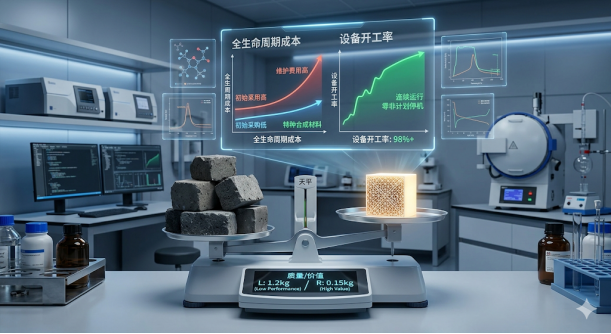
As performance orientation becomes mainstream, procurement standards have become more digitized and quantified. The vague concept of "durability" from the past has been replaced by specific metrics such as thermal shock stability indices, slag erosion rates, and high-temperature creep rates. Buyers are increasingly leaning toward Performance-Based Contracts (PBC), where payments are tied to actual service hours or throughput in operation. This model forces suppliers to transition from selling products to providing services, forming deep strategic partnerships based on risk-and-profit sharing through customized material solutions and remote monitoring.
This shift in procurement trends has directly triggered a "de-commoditization" of the refractory supply chain. SMEs lacking R&D capabilities and relying solely on low costs and sub-standard raw materials are being rapidly phased out by the market. Conversely, service providers with advanced laboratories and system solution capabilities are gaining larger market shares. Especially in emerging fields like anode material firing for new energy batteries and green hydrogen metallurgy, the demands for precision performance are stringent, making high-value specialty refractories the "anchor" of industrial upgrades and establishing high technical barriers.
Looking ahead, the evolution of refractory procurement signals the arrival of a more rational and resilient industrial era. When performance becomes the sole criterion, refractory companies will be compelled to innovate continuously, while downstream users achieve lower carbon emissions and higher energy efficiency through superior materials. This transition in 2026 is not merely a tweak in procurement processes but a necessary path for China's high-temperature industrial chain to move toward the top of the value chain. This win-win situation is driving the industry away from low-level repetitive competition toward a healthy growth track defined by technology.

 0371-65798188
 sjs@shinjiasheng.com
 Tianyi Mansion, Room 1509, No. 129 Huang He Road, Zhengzhou, China