- Home
- About Us
- Products
- Product knowledge
-
News Center
News Center
- Contact Us



In the contemporary era of refined industrial management, the global refractory market is witnessing a profound structural realignment. Historically, market demand oscillated between basic-grade commodities and extreme high-performance materials. However, as of 2026, mid-range refractories have officially claimed their status as the industry mainstream. This shift represents a strategic pivot where enterprises have successfully identified the "golden mean" between long-term operational costs and initial capital expenditure, leveraging materials that offer consistent physical properties without the prohibitive costs of top-tier alternatives.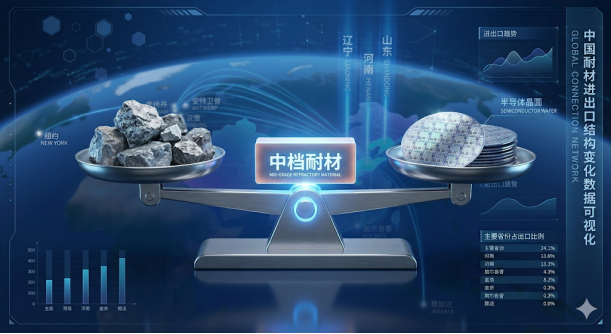
Technologically, the popularity of mid-range refractories is rooted in their exceptional "adaptability." While core applications in steel, cement, and glass kilns involve harsh environments, not every section requires ultra-high-purity materials. By precisely controlling impurity levels and optimizing microstructures, mid-range products provide sufficient erosion and thermal shock resistance to sustain standard production cycles. For most industrial operators, chasing laboratory-grade performance often yields diminishing marginal returns; mid-range materials fill this void by maximizing overall production efficiency.
The optimization of cost structures serves as the primary catalyst for this trend. Rising energy costs and carbon taxes have squeezed profit margins across heavy industries. Mid-range refractories typically require lower energy consumption during manufacturing compared to their ultra-pure counterparts—a factor increasingly relevant in sectors like boron carbide and synthetic corundum production. Companies have found that by strategically deploying mid-range materials in moderate-wear zones, they can significantly reduce procurement costs while minimizing downtime associated with the premature failure of inferior products.
Furthermore, the maturation of global supply chains has paved the way for the dominance of mid-range products. Leading production hubs, such as those in China's Henan and Liaoning provinces, have refined their mass-production techniques to ensure high consistency in mid-grade offerings. This standardized supply capability allows global clients to favor products with abundant availability and predictable quality amidst volatile market conditions. In the B2B sector, mid-range materials now serve as a vital bridge between raw resources and high-precision components, forming a robust industrial backbone.
Looking ahead, the definition of "mid-range" is evolving from a synonym for affordability to an embodiment of "smart industry." Advancements in sensor technology and material monitoring enable enterprises to identify specific stress intensities within their systems more accurately, further refining the application of mid-range solutions. This demand-driven structural upgrade not only enhances the influence of leading suppliers in the global market but also heralds a new era for refractories where efficiency and targeted performance are the ultimate benchmarks of success.

 0371-65798188
 sjs@shinjiasheng.com
 Tianyi Mansion, Room 1509, No. 129 Huang He Road, Zhengzhou, China