- Home
- About Us
- Products
- Product knowledge
-
News Center
News Center
- Contact Us



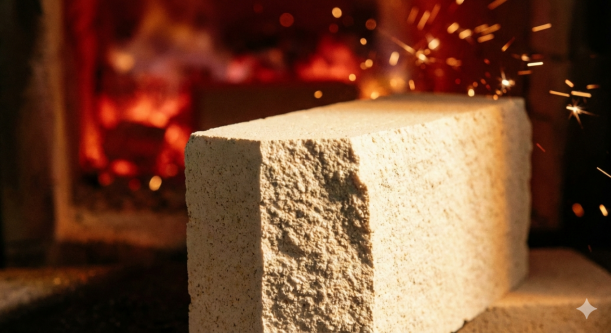
In the world of high-temperature industries, if ordinary red bricks are the “commoners” used to build houses, then high-alumina refractory materials are the “generals” clad in armor, capable of taking on any challenge. Whether at the blazing-hot tapping area of a steel mill or inside the massive rotary kilns of a cement plant, you will always find them at work.
So, what exactly does “high-alumina” mean, and why has it become the most versatile “all-round warrior” in industrial furnaces? Let’s take a closer look at this star of the refractory world.
1. What are high-alumina refractory materials?
As the name suggests, the core of high-alumina refractory materials lies in “alumina.” Their aluminum oxide (Al₂O₃) content is usually above 48%. You can think of them as an upgraded version of clay bricks. The higher the alumina content, the thicker the “armor” of the material, and the stronger its refractory performance and hardness.
Based on alumina content, they are typically classified into three grades:
Grade 1 high-alumina bricks (Al₂O₃ > 75%): The premium version, with extremely high refractoriness, designed to withstand the harshest high-temperature environments.
Grade 2 high-alumina bricks (Al₂O₃ 60%-75%): The cost-performance champion, and the most widely used.
Grade 3 high-alumina bricks (Al₂O₃ 48%-60%): The entry-level option, yet still far superior to ordinary clay bricks.
2. What are their “hardcore” abilities?
High-alumina refractory materials are favored mainly because of three key properties:
High-temperature and high-load resistance: Many materials soften when heated, but high-alumina bricks have a high “refractoriness under load” (usually 1420°C–1550°C or above). This means they can withstand not only extreme heat but also enormous pressure without deforming. Imagine tens of tons of molten steel pressing down on them—they remain unyielding.
Good slag resistance: In furnaces, molten slag acts like a corrosive liquid, acidic or alkaline. High-alumina materials are neutral (slightly acidic), allowing them to resist acidic slags and withstand alkaline slags to a certain extent. This adaptability makes them highly versatile.
Wear resistance: In industrial production, flowing materials constantly abrade the furnace lining. High-alumina bricks have high density and strength, acting like a tough protective skin that endures prolonged friction and wear.
3. Where do they “work”?
Thanks to their balanced performance, high-alumina refractory materials are in demand across multiple industries:
Steel industry: Their main battlefield. High furnaces, hot-blast stoves, and electric furnace roofs all rely on them for protection.
Cement industry: In the decomposition zone of rotary kilns, high-alumina bricks are the backbone, resisting wear and spalling.
Glass industry: While silica bricks dominate glass melting furnaces, high-alumina bricks are still commonly used in the checkerwork of regenerative chambers.
4. Summary
High-alumina refractory materials are not necessarily the most expensive, nor do they excel in every single parameter—but they shine in their “balance.” They strike an ideal equilibrium between refractoriness, strength, and corrosion resistance. For most industrial furnaces, choosing high-alumina materials is often a reliable and economical solution.
Next time you see towering smokestacks and massive factories, remember that these humble grayish-white bricks quietly support the backbone of modern industry, even under thousands of degrees of heat.

 0371-65798188
 sjs@shinjiasheng.com
 Tianyi Mansion, Room 1509, No. 129 Huang He Road, Zhengzhou, China