- Home
- About Us
- Products
- Product knowledge
-
News Center
News Center
- Contact Us



If there were a “High-Temperature Championship” in the world of refractory materials, magnesia-based materials would undoubtedly be the top seed. In steelmaking environments, where highly alkaline slags quickly “defeat” other materials, magnesia-based refractories stand firm. What exactly are their special abilities, and what “fragile” aspects must users be aware of?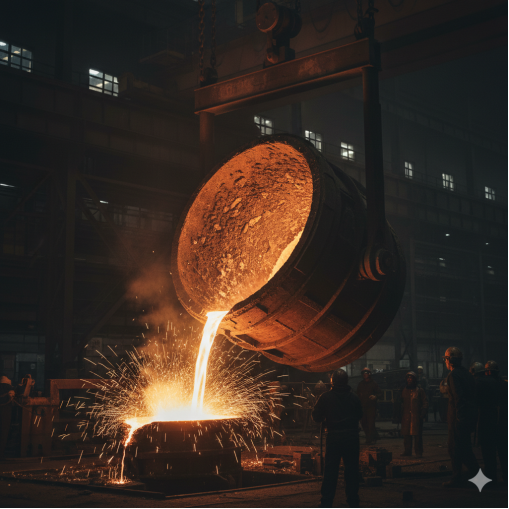
1. Magnesia materials’ “signature moves”: alkali resistance and heat endurance
The main component of magnesia refractories is magnesium oxide (MgO), usually present as periclase. Its advantages are striking, making it practically tailor-made for steelmaking:
Exceptional resistance to alkaline slag attack: This is their core strength. During steelmaking, the slag is typically alkaline (rich in calcium oxide and iron oxide). As the saying goes, “acids neutralize bases.” If an acidic refractory (like silica bricks) encounters alkaline slag, it is quickly corroded. Magnesia-based materials, being strongly alkaline themselves, are naturally immune to alkaline slags. This makes them irreplaceable in alkaline environments such as the bottoms of basic oxygen furnaces and electric furnaces.
Outstanding refractoriness: Magnesium oxide has a melting point as high as 2800°C, meaning magnesia products typically withstand temperatures above 2000°C. Even under extreme heat, their crystal structure remains stable, earning them the title of “refractory king.”
2. Strengths come with “weak spots”
If magnesia materials are so strong, why not use them in every furnace? The answer lies in two significant vulnerabilities that require careful handling:
Poor thermal shock resistance (sensitive to rapid temperature changes): This is the biggest drawback. With a high thermal expansion coefficient, magnesia bricks behave like glass—sudden temperature changes (e.g., an unexpected furnace shutdown or cold air ingress) can cause cracks or even spalling. Handling tip: When using magnesia bricks, heating and cooling must be slow and steady, allowing enough buffer time. They cannot be treated as roughly as high-alumina bricks.
Prone to “hydration” (sensitive to moisture): While MgO is resistant to acids, it is highly reactive with water. In humid storage conditions or during exposure to steam, MgO reacts to form magnesium hydroxide, causing expansion, crumbling, and loosening. Handling tip: Store magnesia bricks in dry, ventilated warehouses with moisture-proof packaging. Use dry laying methods or non-water-based binders (e.g., tar, resin) for installation. If a water-based slurry must be used, it should be freshly mixed and quickly dried.
3. Typical applications
Given these strengths and weaknesses, magnesia refractories have clearly defined roles:
Steelmaking: basic oxygen furnaces and electric furnaces – high alkalinity and high temperature make this the natural stronghold of magnesia bricks, especially magnesia-carbon bricks.
Non-ferrous metal smelting – in copper and lead furnaces, magnesia-chrome bricks are commonly used for corrosion resistance.
Cement rotary kiln sintering zones – these areas experience the highest temperatures, and the clinker is alkaline. Magnesia materials, such as magnesia-alumina spinel bricks, perform exceptionally well here.
4. Summary
Magnesia refractories are like a strong-willed specialist: their strengths are extremely prominent (high-temperature resistance, alkali resistance), but their weaknesses are equally obvious (sensitive to thermal shock and moisture).
Using magnesia materials effectively requires “playing to their strengths and avoiding their weaknesses.” In high-temperature, alkaline, and stable continuous-production environments, they are unbeatable kings. However, in environments with frequent start-stop cycles or high humidity, they may not be the best choice. Understanding the material is key to using it well—this is the true charm of industrial technology.

 0371-65798188
 sjs@shinjiasheng.com
 Tianyi Mansion, Room 1509, No. 129 Huang He Road, Zhengzhou, China