- Home
- About Us
- Products
- Product knowledge
-
News Center
News Center
- Contact Us



In industrial furnaces, temperatures are often far from constant. Adding raw materials, opening furnace doors, and the frequent start-stop cycles of intermittent kilns all subject refractory materials to rapid temperature changes. The ability to withstand such sudden heating and cooling without damage is called thermal shock resistance (or thermal shock stability).
In locations such as the transition zone of cement rotary kilns or the roof of steelmaking electric furnaces, thermal shock resistance is often more critical than refractoriness.
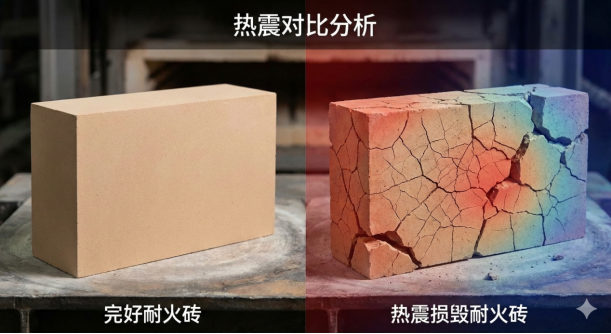
1. Mechanism of thermal shock failure
When a refractory material experiences sudden temperature changes, large thermal stresses develop internally.
Stress caused by temperature gradients: For example, if the surface of a brick suddenly contacts cold air, the surface contracts while the core remains expanded at high temperature. This mismatch in volume change generates tensile stress.
Brittle fracture: Refractory materials are typically brittle (like ceramics), with tensile strength far lower than compressive strength. Once the thermal stress exceeds the material’s tensile limit, cracks form. With repeated thermal cycling, these cracks propagate and eventually lead to surface spalling or complete fracture of the brick.
2. Key factors affecting thermal shock resistance
Coefficient of thermal expansion (CTE): The most important factor. Higher expansion means greater volume change under temperature fluctuations, generating higher thermal stress and reducing thermal shock resistance. For example, silica bricks and magnesia bricks have high CTEs and relatively poor thermal shock resistance, while andalusite and silicon carbide have low CTEs and excellent thermal shock resistance.
Thermal conductivity: Higher conductivity allows rapid equalization of internal and external temperatures, reducing thermal stress. The high thermal conductivity of silicon carbide contributes to its superior thermal shock performance.
Elastic modulus: Lower modulus gives the material more “flexibility,” allowing it to deform slightly and absorb stress without fracturing.
3. Technical approaches to improving thermal shock resistance
To cope with complex operating conditions, material scientists employ several strategies:
Introduction of microcracks (toughening mechanism): Counterintuitive as it may seem, deliberately creating extremely fine microcracks during manufacture allows these cracks to absorb stress energy during thermal shocks, preventing rapid propagation of major cracks—similar to applying a shatterproof film to glass.
Composite material design: For example, adding a mullite phase to brittle alumina creates microstructural mismatches due to differing expansion coefficients, improving thermal shock resistance.
Fiber reinforcement: Incorporating heat-resistant steel or ceramic fibers into unshaped materials provides a “bridging” effect. Even if the matrix cracks, fibers hold the cracks together and prevent material spalling.
4. Summary
Thermal shock resistance is a key indicator of the dynamic performance of refractory materials. When selecting materials, refractoriness alone is insufficient; the furnace operating mode—continuous or intermittent—must be considered. For frequently cycled kilns, choosing materials with a low coefficient of thermal expansion and high thermal shock resistance is essential to prevent early lining spalling and extend maintenance intervals.

 0371-65798188
 sjs@shinjiasheng.com
 Tianyi Mansion, Room 1509, No. 129 Huang He Road, Zhengzhou, China