- Home
- About Us
- Products
- Product knowledge
-
News Center
News Center
- Contact Us



As an unshaped refractory material, castable refractory is gradually replacing traditional refractory bricks due to its short production cycle, high construction efficiency, and excellent monolithic integrity. However, there is a saying in the industry: “30% material, 70% installation.” No matter how good the castable is, improper installation and curing can greatly reduce its service life.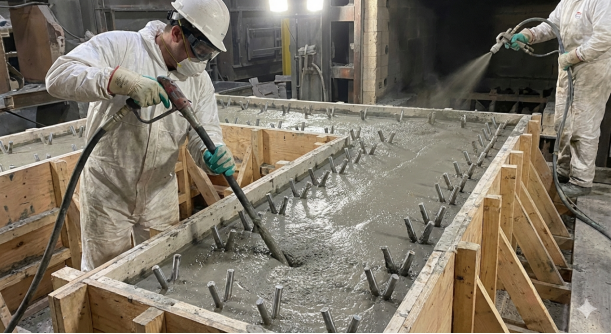
1. Control of mixing and water content
The first step in castable installation is mixing, with the key being water control.
Strict control of the water-to-binder ratio: The amount of water directly affects the castable’s flowability and final strength. Excess water improves workability but leaves numerous pores after drying, reducing strength and slag resistance. Too little water makes the mixture dry and difficult to compact, leading to voids.
Mixing procedure: A forced-action mixer must be used. Typically, dry mix the aggregates and powders for 1–2 minutes for uniform distribution, then gradually add the measured water to achieve a homogeneous wet mix.
2. Pouring and vibration
The casting process must be continuous to avoid cold joints (poor bonding between layers).
Anchoring elements: Metal anchors (dowels) must allow for thermal expansion (e.g., coated with asphalt or wrapped with tape), because metal expands much more than refractory material. Without this, castable can crack during heating.
Vibration for compaction: Insert the vibrator quickly and withdraw slowly to remove air bubbles and ensure the material fills the mold evenly. Over-vibration must be avoided, as it can cause aggregate segregation and slurry separation, compromising homogeneity.
3. Curing: the strength-development phase
After casting, the cement or binder inside the castable requires time to hydrate and develop strength.
Temperature and humidity control: The curing environment is usually kept at 15–25°C. Too low (e.g., winter) and hydration stops; too high and water evaporates too quickly, causing shrinkage cracks.
Natural curing: Maintain moisture for at least 24 hours, then, after mold removal, continue natural curing for 2–3 days to ensure full structural hardening.
4. Drying/initial firing: the most critical stage
Completion of installation does not guarantee success. The first heating (drying/firing) is the most failure-prone phase.
Castables contain a significant amount of free water and chemically bound water. If heated too quickly, the water vaporizes instantly, expanding by thousands of times. The resulting steam pressure, if not released in time, can cause explosion or spalling of the lining.
Strict adherence to the drying curve is essential:
At low temperatures (100–350°C), maintain long soaking times to allow gradual water release.
Add anti-explosion fibers: Some castables incorporate organic fibers that melt at low temperatures to form fine channels, aiding steam escape.
5. Summary
The performance of refractory castables is ultimately realized on-site. Every step—from welding anchors, precise water measurement and mixing, to curing time and firing curve control—affects the overall performance. Standardized construction management is the prerequisite for ensuring castables achieve their designed properties.

 0371-65798188
 sjs@shinjiasheng.com
 Tianyi Mansion, Room 1509, No. 129 Huang He Road, Zhengzhou, China