- Home
- About Us
- Products
- Product knowledge
-
News Center
News Center
- Contact Us



1. Industry Definition and Role
Refractories are materials capable of maintaining stable physical and chemical properties under high temperatures. They are widely used in industries such as steel, non-ferrous metals, cement, glass, and petrochemicals, serving as essential materials that ensure operational stability and efficiency in high-temperature processes.
2. Market Size and Supply-Demand Structure
China remains a dominant player in the global refractory market. In 2023, total output reached approximately 22.9 million tons, with demand at around 20.8 million tons, corresponding to a market size of about RMB 126 billion. The current oversupply structure indicates ongoing price competition and cost pressure, while also driving a shift toward higher-value products.
3. Industry Chain and Raw Materials
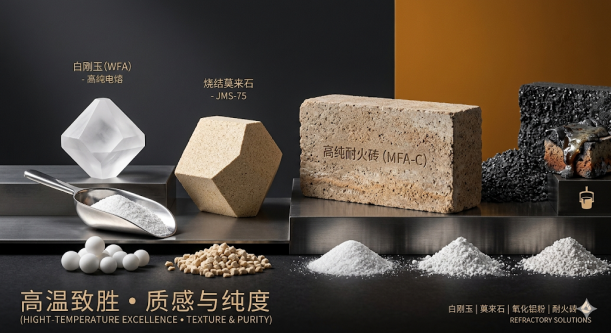
The upstream sector mainly includes natural minerals such as bauxite, magnesite, graphite, and silica, along with processed materials like fused alumina, magnesia, and mullite. The midstream focuses on refractory production, while downstream demand is heavily tied to industries such as steel and cement, making the sector highly cyclical and dependent on industrial activity.
4. Competitive Landscape
The industry is characterized by low entry barriers and fragmentation, with many small and medium-sized enterprises and limited product differentiation. This leads to intense price competition and margin pressure. However, leading companies are gradually gaining market share through technological capabilities, integrated services, and customer relationships, indicating a trend toward consolidation.
5. Growth Drivers
Future growth is expected to be driven by:
Demand-side: Upgrading of steel and high-temperature industries
Supply-side: Environmental policies eliminating outdated capacity
Technology-side: Adoption of high-performance and energy-efficient materials
These factors suggest a gradual shift toward advanced refractory products.
6.Outlook and Scenario Analysis (Assumption)
Under stable macro conditions:
Best case: Higher industry concentration and improved profitability
Base case: Moderate growth (2%–5%) with structural optimization
Worst case: Demand fluctuations in steel leading to intensified price competition
Overall, the industry is expected to transition from scale-driven growth to technology- and service-oriented development.

 0371-65798188
 sjs@shinjiasheng.com
 Tianyi Mansion, Room 1509, No. 129 Huang He Road, Zhengzhou, China