- Home
- About Us
- Products
- Product knowledge
-
News Center
News Center
- Contact Us



(1) Industry Fundamentals (Fact)
Refractories are essential materials for high-temperature industries such as steel, non-ferrous metallurgy, cement, and glass. Their primary function is to ensure operational stability under extreme heat and corrosive conditions. The steel sector accounts for over 60% of total demand, making the industry highly cyclical and closely tied to industrial activity.
(2) Production Scale and Global Position (Fact)
China has become the world’s largest producer and exporter of refractories, maintaining a leading position for years. Historical data shows output reached around 23.45 million tons in 2018, with moderate growth, followed by short-term fluctuations due to downstream demand shifts. Overall, the industry remains large but with slowing growth momentum.
(3) Supply-Demand Dynamics (Fact + Inference)
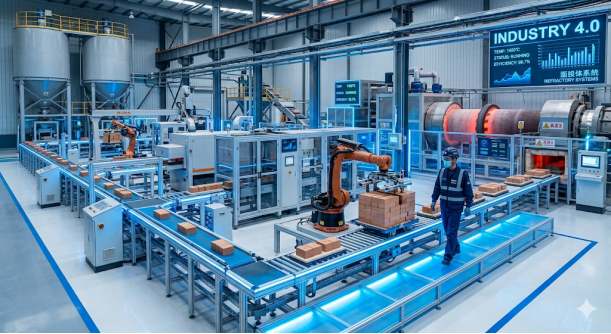
On the supply side, the industry is undergoing structural transformation. While low-end capacity remains oversupplied, demand for high-performance materials (e.g., high-alumina and fused products) continues to grow. Environmental regulations and policy pressure are accelerating the phase-out of inefficient producers, increasing market concentration over time (inference).
(4) Cost Structure and Profit Drivers (Fact + Model)
The refractory industry operates as a hybrid of resource, energy, and manufacturing sectors. Raw materials and energy typically account for more than 60% of production costs. Profitability depends on three core variables:
①.Raw material price trends
②.Steel industry utilization rates
③.Product mix (premium vs. standard)
Profit margins expand during industrial upcycles and contract rapidly during downturns.
(5) Technology and Strategic Direction (Fact + Inference)
Future development is expected to follow three major trends:
①.Green transformation (energy efficiency and recycling)
②.High-end upgrading (longer lifespan and higher purity materials)
③.Integrated services (solution-based offerings instead of product sales)
Among these, recycled refractories and environmentally friendly materials are key focus areas, though commercialization pace remains uncertain.
(6) Market Outlook (Scenario Model)
Based on macroeconomic and steel demand assumptions, three scenarios can be projected:
Best case: Stable steel output + premiumization → CAGR 3–5%
Base case: Stable demand + gradual upgrade → CAGR 1–3%
Worst case: Steel contraction + weak construction demand → CAGR -2% to 1%
In conclusion, the industry is transitioning from volume-driven growth to value-driven competition centered on technology and customer integration.

 0371-65798188
 sjs@shinjiasheng.com
 Tianyi Mansion, Room 1509, No. 129 Huang He Road, Zhengzhou, China